Welcome to Part 3 of the guest submissions, in which we take a retrospective look back at Series 9. Today's guest posts come from Neil Dymond-Green and J.M aka "Life in the Gaps". We begin with Neil's submission. As with the previous posts, which can be found here (part one, part two), they are presented unedited, and need no comment from me. Enjoy!
Rather than go episode by episode through the series, I wanted to examine three areas which bugged me about series 9 of Doctor Who.
Cliffhangers
I was really pleased to hear that Moffat planned to bring back two (or more) parters for series 9. It's been quite a while since a series had more than a smattering of cliffhangers and they are historically quite an element of Doctor Who.
But what is Moffat playing at with them? When I was a child watching Doctor Who, cliffhangers were exciting points to keep you guessing for a week (or less during season 19 when the show was broadcast on Mondays and Tuesdays). But... and for me this is a big but, the excitement was also in wondering how the Doctor or his companion would resolve the cliffhanger and seeing that straight away at the start of the next episode.
And this is not something we got to see during series 9. Instead, the start of the next episode would veer off in a completely different direction. Let's examine them individually:
The Magician's Apprentice's cliffhanger is that Missy and Clara are apparently exterminated. But at the start of The Witch's Familiar there are alive and outside the Dalek city. We then get a vague story about the Doctor before Missy hand-waves away the fact that she used the energy from the Dalek's weapons to activate the transporter.
Under the Lake ends with the Doctor having travelled back in time and apparently reappearing as a ghost. Leaving aside the problem I have with any cliffhanger that says the lead character of the show is dead, we then find ourselves in the TARDIS at the start of Before the Flood with the Doctor addressing the audience (and I hate the fourth wall being broken) about how the story will be resolved with the Bootstrap Paradox. The cliffhanger is again only really addressed later on in a hand wavey 'oh well, it was a hologram all along, see' way.
The Zygon Invasion ends with the Zygon version of Clara shooting down the Doctor's plane. Then, at the start of The Zygon Inversion, we find ourselves in a simulation of Clara's flat. We do find out that Clara is able to (conveniently) influence her counterpart's actions and give the Doctor enough time to escape.
I have no problem with the pseudo cliffhanger of Face the Raven as the next story is effectively the resolution to it. But then we get to the end of Heaven Sent. We're all on Gallifrey, which has been lost for some time, all hell is promised to break loose and it's exciting. You may be able to imagine me actually shouting at the screen when Hell Bent started with the Doctor meeting Clara in a diner.
Over-use and under-use
It must have seemed like a great idea to bring back Kate Stewart for the Zygon two-parter. She effectively fills the role that the Brigadier did for the Third Doctor onwards - a valuable friend and ally, albeit one whose methods the Doctor didn't always completely agree with. But then she is sent off on a pretty pointless mission (on her own? she's in charge of UNIT!) and disappears for a big chunk of the story.
Likewise, Gallifrey. The Doctor's home planet has effectively been missing since the start of the new series and especially since it was somehow locked away at the end of The Day of the Doctor. It's a huge deal that we are finally back there. Except the episode barely manages half an hour there, because of Moffat's obsession with keeping his beloved Clara alive (sort of).
Meanwhile, we get the overuse of veiled comments by the Doctor throughout the series about Clara heading towards death (and how much better would it have been if the fan theories had been true about her already being dead and him snatching some last adventures?). We get repeated allusions to the Hybrid - with the eventual vague, hand-wavey non-answer I've come to expect from Moffat. But then, it felt like Clara had outstayed her welcome in the show by this series anyway.
I'd also argue we had too much of Ashildir/Me during series 9. I didn't feel that she worked as a character - I'm not sure whether this was down to the actor, the writing or a combination thereof. There was little shade to her character. Storywise, it felt unlikely that the Doctor would be rash enough to 'create' her without thinking it through more. Her role in Face the Raven felt very woolly. To be honest, the TIme Lords could have used any agent to get to the Doctor.
And, after the Doctor's words about it not being a good idea for him to travel with an immortal, it felt horrible watching Ashildir and Time Zombie Clara zoom off in the Diner-TARDIS.
It must have seemed like a good idea at the time...
It's long been acknowledged that Moffat seems to have a tendency to come up with 'wow ideas' and throw them into the mix without necessarily worrying about whether they make sense in the context of the story. Here are just some of these ideas I spotted during this series.
In The Witch's Familiar there is a scene which, on one level, is incredibly touching. While discussing the return of Gallifrey, Davros opens his eyes. For once, he is seeing the world naturally. It's beautiful, it's touching - and it's also total BS. So Davros has been able to see for all these years? Why would he sit there with his eyes screwed shut, especially at those moments when Daleks have shot him?
In the same episode, there is a 'humorous' scene of the Doctor zooming around in Davros' chair. To be honest, I can imagine children have been dreaming of that combination since Davros first appearance forty years ago. But to put it in the show? To do so, you have to write the Doctor out of character as someone who would rip a dying man from his life support/wheelchair just to make a joke about a cup of tea with the Daleks?!
We have another dreadfully out-of-character moment in Hell Bent. Again, I can see where the appeal of the idea came from. 'Wow! Let's prove once and for all that Time Lords can change gender when they regenerate! We'll show it on screen because people don't seem quite convinced by the Master/Missy thing. Oh, and while we're at it, we'll show that Time Lords can change skin colour too! Hoorah!' On one level, I applaud this - I have no problem with the idea that regeneration can change a person in all sorts of ways (of course, it had sort of already been shown when Romana regenerated at the beginning of Destiny of the Daleks).
But to do so, Moffat had to write the Doctor horrendously out of character again. The Doctor, a man who abhors guns (and will only usually use them in the most desperate of situations), shoots the General! He doesn't need to. He could pretty much just walk past (he is President, after all). Yes, he asks how many regenerations the General has, but it's been established that regenerating is a fairly traumatic occurrence (and is, for the most part a limited thing). Yet again, a 'wow' idea that really doesn't belong.
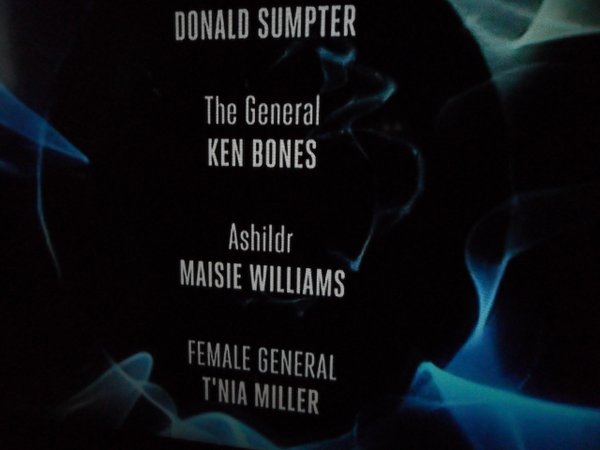
As an aside here, there was a horrible mess with the credits (you can see here, but it was also done this way on screen) for the General, with Ken Bones credited as The General but T'Nia Miller credited as the Female General.
Neil Dymond-Green
Follow Neil on Twitter @neilrdg. He also blogs on a somewhat erratic basis (his words!) at http://neilrdg.wordpress.com
Our second submission comes from J.M, aka "Life Between the Gaps"
UnDoing Series 9
I'm fairly new to the blogging scene - especially when it comes to blogging about specific fandoms.
I've been a fan of Doctor Who since the late 70s/early 80s. And for an American to say that, is quite a feat. Us Americans who grew up with Who are few and far between. (So much, that when I was little, I thought this show aired just for me!) I share that only because it provides a framework for my thoughts and opinions.
One of the unfortunate aspects of Series 9 is that on first watch, I tended to dislike most of the episodes. ("Under the Lake", "Zygon Inversion", and "Heaven Sent" were the exceptions.) I'm not sure if that's due to all the negativity I come across on Social Media, or if it's because of something simply 'wrong' with the production and it takes me until the second or third watch to get past whatever 'wrong' that I noticed on first watch.
To be entirely fair, I had written off Doctor Who with "Death in Heaven" (The Brig as a Cyberman??? Really Moffat? WTH were you thinking?)... But then I found myself in London at Christmas last year and there was no way in hell I wasn't going to watch Doctor Who while I was there! So, I watched "Last Christmas". But it wasn't enough to pull me back into the fandom properly. (Not that I was ever really in the fandom. I'm a fan, but I don't go to cons or buy merchandise or anything like that. Remember, I was the only person in my universe who knew about Doctor Who when I was growing up.)
But this summer, I came across the soundtrack for Series 8, which prompted a proper rewatch - unimpeded by the negativity of social media. I watched it for the soundtrack and found myself watching Peter Capaldi. The man is mesmerising to watch as the Doctor. And between those two elements, I found myself enjoying Doctor Who again.
This doesn't mean there aren't major problems that I find with pretty much each episode. There are. I majored in Theatre, I've been trained to analyse sets, costumes, lighting, acting choices, story line, character arcs, etc. to death. There's always something to complain about. There's also always something to praise.... Which makes this review difficult. Because everything that I wanted to praise Series 9 for from a story-telling point of view was undone by one single episode.
All of that provides framework for the rest of this post. Because those are the circumstances that colour my thoughts and opinions about Series 9. I'm going to be focusing primarily on "Hell Bent," since the intent for that episode was to tie at least the previous three episodes together and the entire Series was hinged upon it.
So, here's the brief Series 9 shake-down (or how all the episodes tie together):
Magician's Apprentice/Witch's Familiar: Confession Dial, "Doctor assumes he's going to win",
Under the Lake/Before the Flood: Doctor warns Clara about being too doctory and tells her he has duty of care.
Girl Who Died: Doctor has duty of care and Clara asks him how he's going to win. "Tidal Waves." "I can do anything"
Woman Who Lived: They could have just skipped this whole adventure, because the applicable bits were at the end when in the pub and consisted of "tidal waves" and "Doctor's leftovers".
Zygon Invasion/Inversion: as much as I WANT these to have a purpose in this season, they really don't. (Well, the Doctor's 'Model of War' speech, but I'll get to that later.)
Sleep No More: Can I pretend I never saw it? However it does serve a purpose because of the images presented without cameras around, made the Doctor search for how the images were projected in the Dial.
Face the Raven: "Doctor's Leftovers are on Trap Street", Clara's attempt to be doctory backfires. Confession Dial
Heaven Sent: Confession Dial, confirmation that being like the Doctor is what killed Clara, How does the Doctor win?
Hell Bent: Confession Dial, "I can do anything"
If I had the chance to go back in time, I would tell myself: "Whatever you do, don't watch 'Hell Bent'. That one episode undoes everything that you love about Series 9." Every single thing. Yes, I wrote up a piece about all the clues that people missed and how that changes the interpretation, but while that fixed everything associated with the "Diner Scenes", it doesn't fix everything.
The biggest issue that remains is the Doctor murdering an unarmed person in cold blood. There was nothing right about that and no excuse you can tell me will ever make that right. Ever. At all. If Stephen Moffat should be sent packing from Doctor Who, it is for that one bit of writing (also the use of b***h and a*s* rank up there as poor choices in a pre-watershed show). I can hear people now, 'But Tenth Doctor pointed a gun at Rassilon and Master.' True, with one profound difference: He didn't kill either of them! That one action erased all that was beautiful and glorious about the Doctor's "Model of War Speech" from "Zygon Inversion". In fact, that "War Speech" makes me a little sick to my stomach when I watch it now. Because it feels hypocritical. "Oh, but the Doctor went through four point five billions years in the Confession Dial, he would come out unstable." Unstable, yes. Killing so pointlessly? No. He had control of the room, all he had to do was move Clara to the lift. No one had to die. I really don't know what Moffat was thinking with that one, and given his writing style, I don't think he knows either other than "Drama".
That said, is it impossible for the Doctor to kill people? No. But then, his instability should have been pressed further. Made clearer. We needed to see more instability earlier in the episode and it just wasn't there. If you want to break the Doctor, fine. I can get behind that. I've Roleplayed and written enough fanfics with broken!Doctor to understand the appeal. But don't do a half-way job that just ends up with things coming off as out of character. The Doctor can break, but he tends to break in very specific ways (Consider Nine in "Dalek", Ten in "Waters of Mars", or Five after "Planet of Fire").
I was going to do a bit of analysis of 'actor choice' verses 'director vision' verses 'writer intent'. But then, I came across scripts for "Heaven Sent" and "Hell Bent" posted on the BBC Website. I decided it was pointless to do any proper analysis because Moffat is a micromanager script writer. He not only gives detailed camera angles, but he dictates specific facial expressions to be given at specific points. Basically, Moffat's scripts (at least those two) don't leave a lot of room for debate or creativity. That said, I'm left asking "What was the Doctor's Motivation for killing the General?" The only explanation we're given is when the Doctor says to Clara "It was him or you." No. There were a dozen options besides killing the General. So, I'm left with no choice but to chalk that up to bad writing. Moffat has detailed so many other things and all we get here is "Horror: the Doctor shoots him." Sorry, that's not good enough. I need to know the Doctor's mental processes that led to the decision to kill instead of running.
Bringing Clara back from the dead indefinitely was another major problem. For once I'm going to agree with Ashildr: Clara's death was beautiful. Even if I didn't care for the plot of "Face the Raven", even if I felt some aspects dragged on too long, the set-up for Clara's death and her speech to the Doctor just prior to her facing the raven was extraordinary.
I admit, I've never been a fan of Clara. I didn't hate her, I was just underwhelmed. Then, especially post-Danny Pink, she finally started to have depth and scope and was more than just an "I'm a special snowflake, so like me" character. I started to sort of care what happened to her. The fact that she had this exquisite death that was on par with Adric's death in 1982, well, nearly had me in tears. For a character I don't care for? That's a pretty admirable accomplishment.
But with "Hell Bent" she's back and who knows for how long. She had this glorious death and it meant nothing. That's not an 'interesting plot twist.' It completely undid everything that came before. Even all of Clara's echoes saving the Doctor. Maybe they weren't echoes. Maybe they were all her post-death. (See how easy it is to completely change all of Series 7 and 8 as well?) This is not clever, this was just poor story-telling.
The Doctor in both "Heaven Sent" and "Hell Bent" is presented to be traumatised by Clara's death. It's as if he's never been through anything like that before. Okay, so back in "Girl Who Died", he said:
"I'll lose any war you like. I'm sick of losing people. Look at you, with your eyes, and your never giving up, and your anger, and your kindness. One day, the memory of that will hurt so much that I won't be able to breathe, and I'll do what I always do. I'll get in my box and I'll run and I'll run, in case all the pain ever catches up."
Yes he did say that. And why do you think he knows that's how he'll react? It's because he's been through it before. It's like he says at the end of that episode, "Immortality isn't living forever. That's not what it feels like. Immortality is everybody else dying."
He knows that because he's lived it before. Going all the way back to the first companion death: Katarina and as recently as the Pond-Williams. So what the heck made Clara's death so special that her death in particular would be what drove him to break the rules (again)? I need that explained. And that is a reflection of poor writing as well. From someone who writes as many details into the script as Moffat does, I expect more. (Maybe if he spent less time trying to dictate actor/director choices and more time telling the story, things would be different.)
It's as if with each series, Moffat ignores everything that happened before. And there's a big problem with that. This Doctor is the same Doctor as he was when he looked like William Hartnell. Are you seriously trying to tell me that when the Doctor went through all this hubris when he looked like David Tennant on Mars that he would just forget it all? Heck, he had made a Tidal wave in Ashildr and questioned himself about it and that wouldn't stop him? Basically from a Character Development standpoint "Hell Bent" doesn't make an ounce of sense, either within Series 9 contained or within all of Who history as a whole.
Worse than everything else though, "Hell Bent" undoes everything I loved about Series 9 and everything I started to like about Clara as a character. Even the episodes where I liked Clara "Under the Lake", "Girl Who Died", and "Face the Raven", I can't like now, knowing that all that amazing character growth was undone in "Hell Bent".
About the only part that was 'right' without needing any amount of mental gymnastics to fix was how the TARDIS 'booted up'/welcomed the Doctor upon his return. So watch the first 18 or so minutes and the last three minutes and then the Series holds up. If you watch the rest, then "Hell Bent" goes down the drain and takes the rest of the series with it.
Thoughts on Doctor Who Series 9
Rather than go episode by episode through the series, I wanted to examine three areas which bugged me about series 9 of Doctor Who.
Cliffhangers
I was really pleased to hear that Moffat planned to bring back two (or more) parters for series 9. It's been quite a while since a series had more than a smattering of cliffhangers and they are historically quite an element of Doctor Who.
But what is Moffat playing at with them? When I was a child watching Doctor Who, cliffhangers were exciting points to keep you guessing for a week (or less during season 19 when the show was broadcast on Mondays and Tuesdays). But... and for me this is a big but, the excitement was also in wondering how the Doctor or his companion would resolve the cliffhanger and seeing that straight away at the start of the next episode.
And this is not something we got to see during series 9. Instead, the start of the next episode would veer off in a completely different direction. Let's examine them individually:
The Magician's Apprentice's cliffhanger is that Missy and Clara are apparently exterminated. But at the start of The Witch's Familiar there are alive and outside the Dalek city. We then get a vague story about the Doctor before Missy hand-waves away the fact that she used the energy from the Dalek's weapons to activate the transporter.
Under the Lake ends with the Doctor having travelled back in time and apparently reappearing as a ghost. Leaving aside the problem I have with any cliffhanger that says the lead character of the show is dead, we then find ourselves in the TARDIS at the start of Before the Flood with the Doctor addressing the audience (and I hate the fourth wall being broken) about how the story will be resolved with the Bootstrap Paradox. The cliffhanger is again only really addressed later on in a hand wavey 'oh well, it was a hologram all along, see' way.
The Zygon Invasion ends with the Zygon version of Clara shooting down the Doctor's plane. Then, at the start of The Zygon Inversion, we find ourselves in a simulation of Clara's flat. We do find out that Clara is able to (conveniently) influence her counterpart's actions and give the Doctor enough time to escape.
I have no problem with the pseudo cliffhanger of Face the Raven as the next story is effectively the resolution to it. But then we get to the end of Heaven Sent. We're all on Gallifrey, which has been lost for some time, all hell is promised to break loose and it's exciting. You may be able to imagine me actually shouting at the screen when Hell Bent started with the Doctor meeting Clara in a diner.
Over-use and under-use
It must have seemed like a great idea to bring back Kate Stewart for the Zygon two-parter. She effectively fills the role that the Brigadier did for the Third Doctor onwards - a valuable friend and ally, albeit one whose methods the Doctor didn't always completely agree with. But then she is sent off on a pretty pointless mission (on her own? she's in charge of UNIT!) and disappears for a big chunk of the story.
Likewise, Gallifrey. The Doctor's home planet has effectively been missing since the start of the new series and especially since it was somehow locked away at the end of The Day of the Doctor. It's a huge deal that we are finally back there. Except the episode barely manages half an hour there, because of Moffat's obsession with keeping his beloved Clara alive (sort of).
Meanwhile, we get the overuse of veiled comments by the Doctor throughout the series about Clara heading towards death (and how much better would it have been if the fan theories had been true about her already being dead and him snatching some last adventures?). We get repeated allusions to the Hybrid - with the eventual vague, hand-wavey non-answer I've come to expect from Moffat. But then, it felt like Clara had outstayed her welcome in the show by this series anyway.
I'd also argue we had too much of Ashildir/Me during series 9. I didn't feel that she worked as a character - I'm not sure whether this was down to the actor, the writing or a combination thereof. There was little shade to her character. Storywise, it felt unlikely that the Doctor would be rash enough to 'create' her without thinking it through more. Her role in Face the Raven felt very woolly. To be honest, the TIme Lords could have used any agent to get to the Doctor.
And, after the Doctor's words about it not being a good idea for him to travel with an immortal, it felt horrible watching Ashildir and Time Zombie Clara zoom off in the Diner-TARDIS.
It must have seemed like a good idea at the time...
It's long been acknowledged that Moffat seems to have a tendency to come up with 'wow ideas' and throw them into the mix without necessarily worrying about whether they make sense in the context of the story. Here are just some of these ideas I spotted during this series.
In The Witch's Familiar there is a scene which, on one level, is incredibly touching. While discussing the return of Gallifrey, Davros opens his eyes. For once, he is seeing the world naturally. It's beautiful, it's touching - and it's also total BS. So Davros has been able to see for all these years? Why would he sit there with his eyes screwed shut, especially at those moments when Daleks have shot him?
In the same episode, there is a 'humorous' scene of the Doctor zooming around in Davros' chair. To be honest, I can imagine children have been dreaming of that combination since Davros first appearance forty years ago. But to put it in the show? To do so, you have to write the Doctor out of character as someone who would rip a dying man from his life support/wheelchair just to make a joke about a cup of tea with the Daleks?!
We have another dreadfully out-of-character moment in Hell Bent. Again, I can see where the appeal of the idea came from. 'Wow! Let's prove once and for all that Time Lords can change gender when they regenerate! We'll show it on screen because people don't seem quite convinced by the Master/Missy thing. Oh, and while we're at it, we'll show that Time Lords can change skin colour too! Hoorah!' On one level, I applaud this - I have no problem with the idea that regeneration can change a person in all sorts of ways (of course, it had sort of already been shown when Romana regenerated at the beginning of Destiny of the Daleks).
But to do so, Moffat had to write the Doctor horrendously out of character again. The Doctor, a man who abhors guns (and will only usually use them in the most desperate of situations), shoots the General! He doesn't need to. He could pretty much just walk past (he is President, after all). Yes, he asks how many regenerations the General has, but it's been established that regenerating is a fairly traumatic occurrence (and is, for the most part a limited thing). Yet again, a 'wow' idea that really doesn't belong.
As an aside here, there was a horrible mess with the credits (you can see here, but it was also done this way on screen) for the General, with Ken Bones credited as The General but T'Nia Miller credited as the Female General.
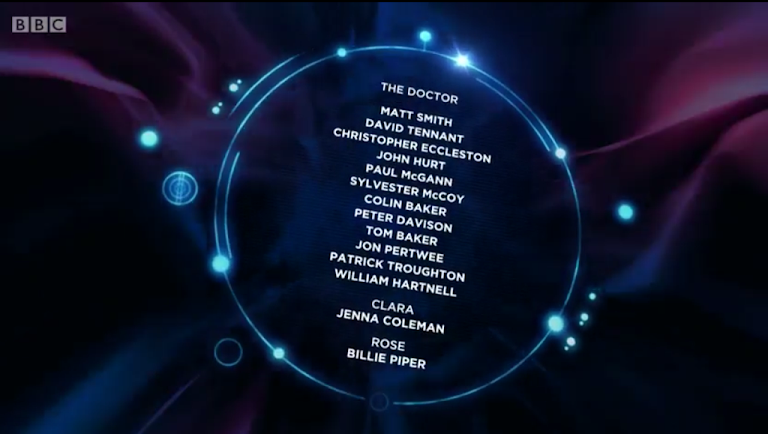
Why not credit them both as The General? It's not like multiple actors haven't been credited for the Doctor..
Neil Dymond-Green
Follow Neil on Twitter @neilrdg. He also blogs on a somewhat erratic basis (his words!) at http://neilrdg.wordpress.com
Our second submission comes from J.M, aka "Life Between the Gaps"
UnDoing Series 9
I'm fairly new to the blogging scene - especially when it comes to blogging about specific fandoms.
I've been a fan of Doctor Who since the late 70s/early 80s. And for an American to say that, is quite a feat. Us Americans who grew up with Who are few and far between. (So much, that when I was little, I thought this show aired just for me!) I share that only because it provides a framework for my thoughts and opinions.
One of the unfortunate aspects of Series 9 is that on first watch, I tended to dislike most of the episodes. ("Under the Lake", "Zygon Inversion", and "Heaven Sent" were the exceptions.) I'm not sure if that's due to all the negativity I come across on Social Media, or if it's because of something simply 'wrong' with the production and it takes me until the second or third watch to get past whatever 'wrong' that I noticed on first watch.
To be entirely fair, I had written off Doctor Who with "Death in Heaven" (The Brig as a Cyberman??? Really Moffat? WTH were you thinking?)... But then I found myself in London at Christmas last year and there was no way in hell I wasn't going to watch Doctor Who while I was there! So, I watched "Last Christmas". But it wasn't enough to pull me back into the fandom properly. (Not that I was ever really in the fandom. I'm a fan, but I don't go to cons or buy merchandise or anything like that. Remember, I was the only person in my universe who knew about Doctor Who when I was growing up.)
But this summer, I came across the soundtrack for Series 8, which prompted a proper rewatch - unimpeded by the negativity of social media. I watched it for the soundtrack and found myself watching Peter Capaldi. The man is mesmerising to watch as the Doctor. And between those two elements, I found myself enjoying Doctor Who again.
This doesn't mean there aren't major problems that I find with pretty much each episode. There are. I majored in Theatre, I've been trained to analyse sets, costumes, lighting, acting choices, story line, character arcs, etc. to death. There's always something to complain about. There's also always something to praise.... Which makes this review difficult. Because everything that I wanted to praise Series 9 for from a story-telling point of view was undone by one single episode.
All of that provides framework for the rest of this post. Because those are the circumstances that colour my thoughts and opinions about Series 9. I'm going to be focusing primarily on "Hell Bent," since the intent for that episode was to tie at least the previous three episodes together and the entire Series was hinged upon it.
So, here's the brief Series 9 shake-down (or how all the episodes tie together):
Magician's Apprentice/Witch's Familiar: Confession Dial, "Doctor assumes he's going to win",
Under the Lake/Before the Flood: Doctor warns Clara about being too doctory and tells her he has duty of care.
Girl Who Died: Doctor has duty of care and Clara asks him how he's going to win. "Tidal Waves." "I can do anything"
Woman Who Lived: They could have just skipped this whole adventure, because the applicable bits were at the end when in the pub and consisted of "tidal waves" and "Doctor's leftovers".
Zygon Invasion/Inversion: as much as I WANT these to have a purpose in this season, they really don't. (Well, the Doctor's 'Model of War' speech, but I'll get to that later.)
Sleep No More: Can I pretend I never saw it? However it does serve a purpose because of the images presented without cameras around, made the Doctor search for how the images were projected in the Dial.
Face the Raven: "Doctor's Leftovers are on Trap Street", Clara's attempt to be doctory backfires. Confession Dial
Heaven Sent: Confession Dial, confirmation that being like the Doctor is what killed Clara, How does the Doctor win?
Hell Bent: Confession Dial, "I can do anything"
If I had the chance to go back in time, I would tell myself: "Whatever you do, don't watch 'Hell Bent'. That one episode undoes everything that you love about Series 9." Every single thing. Yes, I wrote up a piece about all the clues that people missed and how that changes the interpretation, but while that fixed everything associated with the "Diner Scenes", it doesn't fix everything.
The biggest issue that remains is the Doctor murdering an unarmed person in cold blood. There was nothing right about that and no excuse you can tell me will ever make that right. Ever. At all. If Stephen Moffat should be sent packing from Doctor Who, it is for that one bit of writing (also the use of b***h and a*s* rank up there as poor choices in a pre-watershed show). I can hear people now, 'But Tenth Doctor pointed a gun at Rassilon and Master.' True, with one profound difference: He didn't kill either of them! That one action erased all that was beautiful and glorious about the Doctor's "Model of War Speech" from "Zygon Inversion". In fact, that "War Speech" makes me a little sick to my stomach when I watch it now. Because it feels hypocritical. "Oh, but the Doctor went through four point five billions years in the Confession Dial, he would come out unstable." Unstable, yes. Killing so pointlessly? No. He had control of the room, all he had to do was move Clara to the lift. No one had to die. I really don't know what Moffat was thinking with that one, and given his writing style, I don't think he knows either other than "Drama".
That said, is it impossible for the Doctor to kill people? No. But then, his instability should have been pressed further. Made clearer. We needed to see more instability earlier in the episode and it just wasn't there. If you want to break the Doctor, fine. I can get behind that. I've Roleplayed and written enough fanfics with broken!Doctor to understand the appeal. But don't do a half-way job that just ends up with things coming off as out of character. The Doctor can break, but he tends to break in very specific ways (Consider Nine in "Dalek", Ten in "Waters of Mars", or Five after "Planet of Fire").
I was going to do a bit of analysis of 'actor choice' verses 'director vision' verses 'writer intent'. But then, I came across scripts for "Heaven Sent" and "Hell Bent" posted on the BBC Website. I decided it was pointless to do any proper analysis because Moffat is a micromanager script writer. He not only gives detailed camera angles, but he dictates specific facial expressions to be given at specific points. Basically, Moffat's scripts (at least those two) don't leave a lot of room for debate or creativity. That said, I'm left asking "What was the Doctor's Motivation for killing the General?" The only explanation we're given is when the Doctor says to Clara "It was him or you." No. There were a dozen options besides killing the General. So, I'm left with no choice but to chalk that up to bad writing. Moffat has detailed so many other things and all we get here is "Horror: the Doctor shoots him." Sorry, that's not good enough. I need to know the Doctor's mental processes that led to the decision to kill instead of running.
Bringing Clara back from the dead indefinitely was another major problem. For once I'm going to agree with Ashildr: Clara's death was beautiful. Even if I didn't care for the plot of "Face the Raven", even if I felt some aspects dragged on too long, the set-up for Clara's death and her speech to the Doctor just prior to her facing the raven was extraordinary.
I admit, I've never been a fan of Clara. I didn't hate her, I was just underwhelmed. Then, especially post-Danny Pink, she finally started to have depth and scope and was more than just an "I'm a special snowflake, so like me" character. I started to sort of care what happened to her. The fact that she had this exquisite death that was on par with Adric's death in 1982, well, nearly had me in tears. For a character I don't care for? That's a pretty admirable accomplishment.
But with "Hell Bent" she's back and who knows for how long. She had this glorious death and it meant nothing. That's not an 'interesting plot twist.' It completely undid everything that came before. Even all of Clara's echoes saving the Doctor. Maybe they weren't echoes. Maybe they were all her post-death. (See how easy it is to completely change all of Series 7 and 8 as well?) This is not clever, this was just poor story-telling.
The Doctor in both "Heaven Sent" and "Hell Bent" is presented to be traumatised by Clara's death. It's as if he's never been through anything like that before. Okay, so back in "Girl Who Died", he said:
"I'll lose any war you like. I'm sick of losing people. Look at you, with your eyes, and your never giving up, and your anger, and your kindness. One day, the memory of that will hurt so much that I won't be able to breathe, and I'll do what I always do. I'll get in my box and I'll run and I'll run, in case all the pain ever catches up."
Yes he did say that. And why do you think he knows that's how he'll react? It's because he's been through it before. It's like he says at the end of that episode, "Immortality isn't living forever. That's not what it feels like. Immortality is everybody else dying."
He knows that because he's lived it before. Going all the way back to the first companion death: Katarina and as recently as the Pond-Williams. So what the heck made Clara's death so special that her death in particular would be what drove him to break the rules (again)? I need that explained. And that is a reflection of poor writing as well. From someone who writes as many details into the script as Moffat does, I expect more. (Maybe if he spent less time trying to dictate actor/director choices and more time telling the story, things would be different.)
It's as if with each series, Moffat ignores everything that happened before. And there's a big problem with that. This Doctor is the same Doctor as he was when he looked like William Hartnell. Are you seriously trying to tell me that when the Doctor went through all this hubris when he looked like David Tennant on Mars that he would just forget it all? Heck, he had made a Tidal wave in Ashildr and questioned himself about it and that wouldn't stop him? Basically from a Character Development standpoint "Hell Bent" doesn't make an ounce of sense, either within Series 9 contained or within all of Who history as a whole.
Worse than everything else though, "Hell Bent" undoes everything I loved about Series 9 and everything I started to like about Clara as a character. Even the episodes where I liked Clara "Under the Lake", "Girl Who Died", and "Face the Raven", I can't like now, knowing that all that amazing character growth was undone in "Hell Bent".
About the only part that was 'right' without needing any amount of mental gymnastics to fix was how the TARDIS 'booted up'/welcomed the Doctor upon his return. So watch the first 18 or so minutes and the last three minutes and then the Series holds up. If you watch the rest, then "Hell Bent" goes down the drain and takes the rest of the series with it.
You can follow J.M on Twitter at @lifeinthegaps and read her blog, which you can find at http://life-in-the-gaps.blogspot.com/
My thanks to Neil and J.M for taking the time and effort to write for me.. It is very much appreciated!


